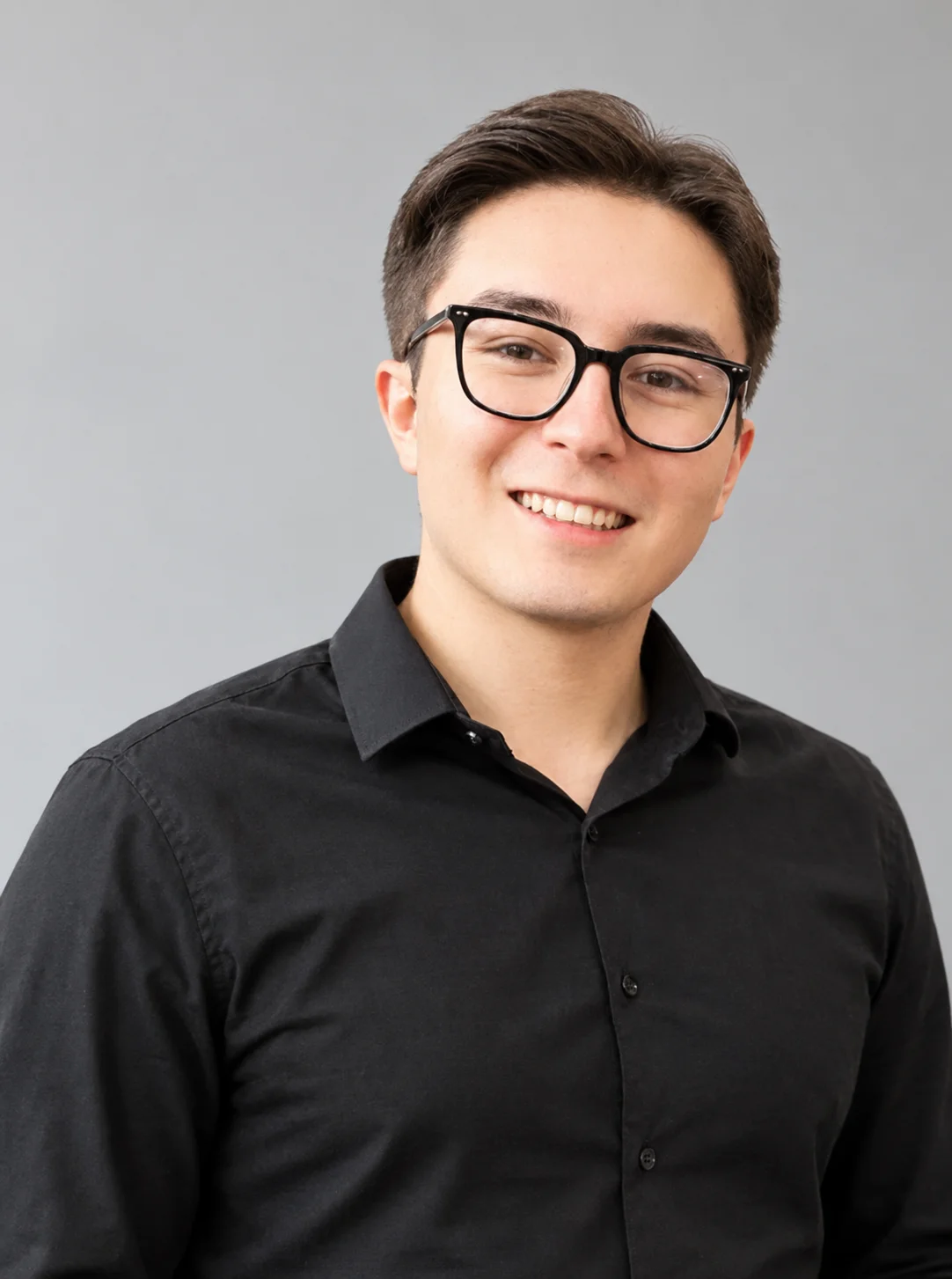
Physicist · Machine Learning · Puebla, México

Rafael
Sánchez Cedillo

M.Sc. in Applied Physics. Three years building machine-learning systems that run in production. Now I want to understand, from first principles, why they work.

Rafael Sánchez Cedillo
01 · Direction

The statistical physics
of learning.

For the past three years I have applied machine learning to concrete problems: legal search, solar-panel diagnostics, inference on biological systems. The systems worked. What I kept running into was that I could make them work far better than I could explain them.

That gap is what I want to work on. I am pursuing a PhD in the statistical physics of learning — using the tools of disordered systems to build a theory of neural networks from first principles.

  • 01
    Spin-glass methods and the geometry of high-dimensional loss landscapes.
  • 02
    Renormalization-group ideas applied to representations in deep networks.
  • 03
    When inference is possible at all: thresholds and phase transitions in learning problems.
02 · Research

Inverse problems
in dynamical systems.

M.Sc. Thesis · BUAP · 2023

Parameterization of gene regulatory networks using machine-learning techniques

Advisors: Dr. Jorge Velázquez Castro and Dr. Benito de Celis Alonso · Graduate Program in Applied Physics, FCFM-BUAP

Gene regulatory networks are modeled as systems of nonlinear differential equations whose parameters cannot be measured directly. I trained neural networks on simulated trajectories to learn the inverse map — from observed dynamics back to the parameters that generated them.

The same idea runs through most of what I build: a forward model that is easy to simulate, and a learned inverse that recovers what is hidden.

ODE model→simulated trajectories→neural network→inferred parameters
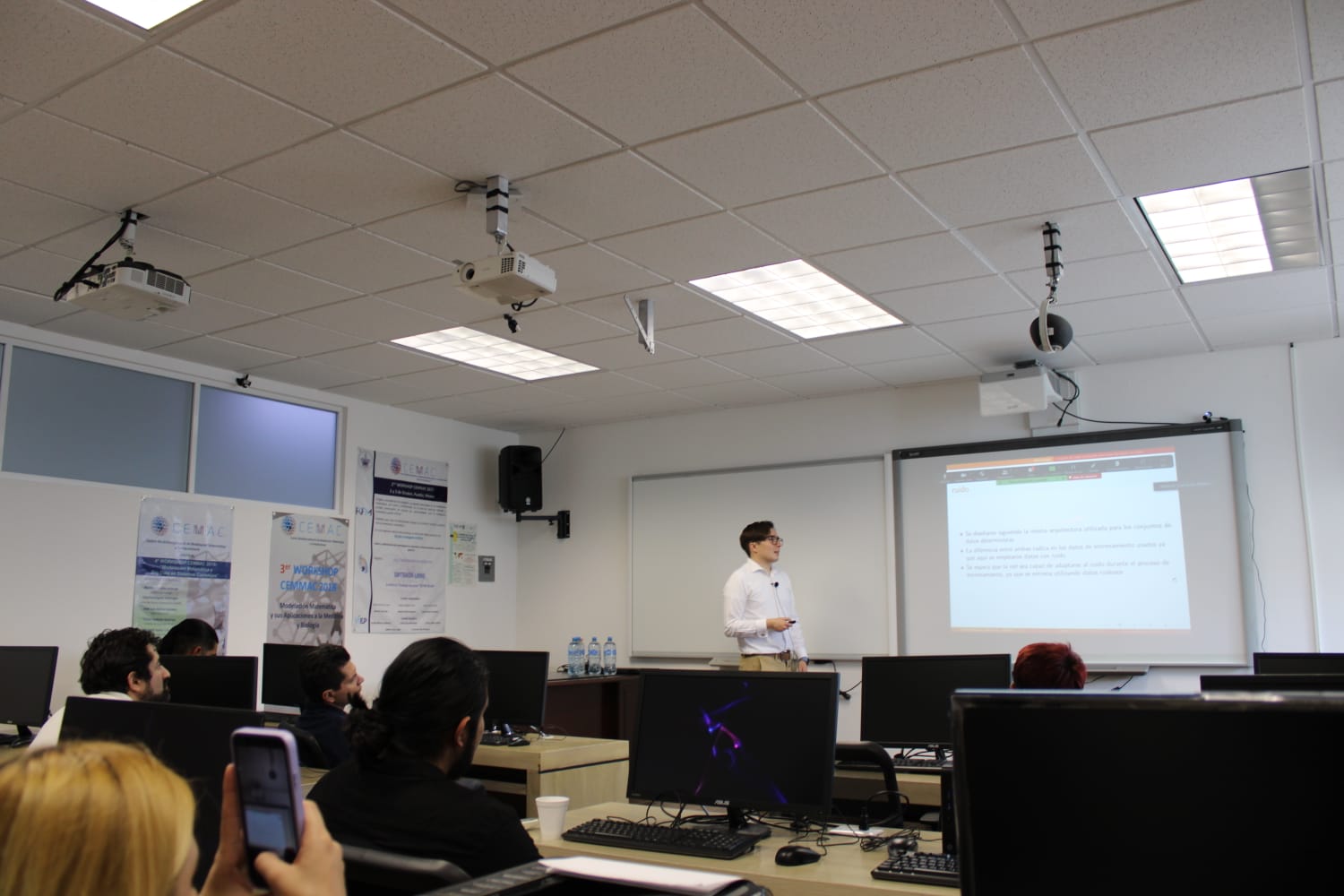
Rafael Sánchez Cedillo presenting his thesis results
Presenting the thesis results: training the inverse network on noisy data, so it learns to recover parameters despite the noise.

Parameter identification in gene regulatory networks through neural networks

Chapter author · Proceedings, XVI International Week of Statistics and Probability

Chapter · 2023

Parameter identification in gene regulation systems using AI

XVI National Congress of Physics, Morelia

Talk · 2023

Stellar classification using machine learning

Conference talk

Talk · 2023

Diabetes risk assessment based on machine learning

2nd Meeting of Medical Physics, BUAP

Poster · 2023
03 · Selected work

Models of things
that move.

Independent projects, all running live on tierrayalmapr.com, the platform I built and maintain on my own.

Live · Statistical inference

Football match projections

A probabilistic forecaster in which the physics is the architecture: goals are two conditionally independent Poisson processes, and the forward pass is the exact, differentiable Poisson likelihood — no hidden layers approximating it. Team attack, defence and home advantage are interpretable scalars; matchup effects come from a bilinear term between learned 4-dimensional style vectors, which keeps the pairwise interaction at O(N·k) instead of O(N²). The time scale of the data is itself learned: the decay rate converges to a half-life of about 119 days.

≈11,000Parameters
16Leagues, refit daily
50–55%Outcome accuracy · 45% baseline
The thesis method moved to a new domain: observe noisy outputs, infer the latent parameters of the system that produced them.
PyTorch · walk-forward validation · Optuna · Flask · SQLite · ESPN data
Live · Agent-based simulation

Traffic simulation of Puebla

A continuous particle simulation on the city's real road network. Vehicles follow a Gipps-type safe-speed rule, queues spill back from one street to the next, routes are chosen stochastically at each intersection with time-of-day attraction zones, and signal cycles are modeled so that phase drift between crossings can be computed. State streams to the browser quantized to 5 bytes per vehicle, with at most 0.4 m of error at city scale.

67,216Nodes
160,332Edges
210,152Vehicles
Node.js · typed arrays · Flask · Leaflet · Canvas · OpenStreetMap
Live · Acoustics

Chords as superposed waves

An interactive note on the physics of guitar harmony: why the major triad's 4 : 5 : 6 ratios sound stable, how equal temperament misses them by up to 15.6 cents and produces audible beats, and a plucked-string synthesizer built from Karplus–Strong with the Jaffe–Smith extensions. Every figure computes and plays its own sound.

Web Audio API · Karplus–Strong synthesis · Canvas · no dependencies
Product · LLM pipeline

Tierra y Alma

Personalized relaxation audio in Spanish, generated in real time. A language model reads the emotional state a user describes, writes a tailored script, and turns it into natural speech.

LLMs · text-to-speech · full-stack web · sole developer
Smaller experiments
In production
Legal tech · BuhoLegal

Hybrid legal search

Semantic and BM25 retrieval over Mexican jurisprudence, with agent-based pipelines that draft answers grounded in the retrieved documents.

OpenAI embeddings · Elasticsearch · Django · GCP · Docker
Energy · Neurotry

Anomaly detection in solar systems

Models for performance optimization and early warning in photovoltaic installations, combining thermal analysis with classification to catch failing components before they fail.

Time series · anomaly detection · classification
04 · Experience

From the lab
to production.

2026 — present

Founder & Developer · Tierra y Alma

  • Conceived, built and launched a platform that generates personalized relaxation audio in Spanish in real time from the emotional state a user describes.
  • Designed the full pipeline: a language model interprets the user's state, writes a tailored script and turns it into natural speech.
  • Run the site as a lab for my own models and technical notes: football projections, the Puebla traffic simulation, interactive physics.
  • Sole owner, from product and engineering to brand and social presence.
May 2025 — present

Director of Artificial Intelligence · BuhoLegal, Puebla

  • Lead the company's APIs: I design, build and keep them running, including fixing bugs in production. They are the services BuhoLegal's products run on.
  • Manage the platform's databases and run the company's data analysis.
  • Own the Python/Django backend and the infrastructure behind it: multi-server Elasticsearch, GCP deployment with Docker, SCJN document scraping and AWS SES email pipelines.
  • Lead the company's AI projects, among them a hybrid semantic + BM25 legal search system and agent-based pipelines that generate answers grounded in retrieved jurisprudence.
Oct 2024 — Jun 2025

Artificial Intelligence Specialist · Neurotry

  • Developed ML models for performance optimization and anomaly detection in solar photovoltaic systems.
  • Applied thermal analysis and early-warning classification to reduce failure rates in critical components.
Jul 2024 — Oct 2024

AI Research Assistant · UDLAP, Universidad de las Américas Puebla

  • Designed and deployed a local web system for automated laboratory-equipment registration and usage tracking.
  • Supported applied computer-vision research for academic projects.
Feb 2024 — Jul 2024

Python Developer, AI Specialization · BLIFE

  • Built an NLP chatbot for automated customer service.
  • Designed AI algorithms for sales optimization and internal analytics.
2024 — 2025

Mathematics Teacher · Colegio Luminos

  • Prepared students for national and international mathematics competitions.
2022

Undergraduate Instructor, Contemporary Physics · BUAP

  • Taught theory with integrated laboratory work.
2022

Data Science Tutor · Coderhouse

  • Online instruction in machine learning, SQL and applied data analysis for international students.
2021

Data Science Intern · BuhoLegal

  • Classification and analysis algorithms for the legal sector — the start of the work I later came back to lead.
05 · Education

Trained as a
physicist.

2022 — 2023

M.Sc. Applied Physics

Benemérita Universidad Autónoma de Puebla

GPA 9.69 / 10. Thesis on machine-learning inference of parameters in gene regulatory networks. Read the thesis
2017 — 2021

B.Sc. Physics

Benemérita Universidad Autónoma de Puebla

Minicourse: Epidemic Modeling for Pandemic Preparedness, ICTP-SAIFR (2023).

Machine learning

PyTorch, TensorFlow, scikit-learn, NLP and embeddings, computer vision, local LLMs

Systems

Python, Django, Flask, Elasticsearch, Docker, GCP, Node.js, SQL

Languages & tools

Spanish (native), English (C1) · LaTeX, MATLAB, D3.js

06 · Contact

Let's talk.

I'm glad to hear from research groups working on the theory of learning, and from anyone with a hard inference problem.